
Proteins revision notes 3.1.4
Proteins do most of the work in cells. What a protein does depends on its shape, and its shape depends on the order of its amino acids. Most of this section follows from that one idea.
- Specification 3.1.4
- Level AS and A-level
- Price Free
Practise this section
Test yourself under exam conditions
Amino acids and peptide bonds
Amino acids are the monomers of proteins. All 20 share one general structure: a central carbon atom joined to an amine group (NH₂), a carboxyl group (COOH), a hydrogen atom and an R group (side chain). Only the R group differs, and it sets the properties of the amino acid.
Two amino acids join in a condensation reaction, which makes a peptide bond and releases water. The amine group of one joins the carboxyl group of the next. Two amino acids make a dipeptide, and many make a polypeptide. A working protein contains one or more polypeptides. Hydrolysis breaks peptide bonds using water.
Four levels of structure
| Level | What it is | Held by |
|---|---|---|
| Primary | The sequence of amino acids in a polypeptide | Peptide bonds |
| Secondary | Folding or coiling of the polypeptide | Hydrogen bonds |
| Tertiary | Further folding into a specific shape | Hydrogen bonds, ionic bonds and disulfide bridges between R groups |
| Quaternary | More than one polypeptide joined together | Bonds between the polypeptides, such as disulfide bridges |
Follow the chain of cause and effect. A different sequence of amino acids puts R groups in different places. Different bonds form, so the tertiary structure changes. The protein may then no longer bind what it should.
The same idea applies to proteins that are not enzymes. A receptor or an antibody has a specific tertiary structure, so it is complementary to a specific molecule, such as a hormone or an antigen. Carrier and channel proteins also depend on their shape to move substances across membranes.
The biuret test
Add biuret solution to the sample. A purple colour shows that protein is present. Do not heat it. A sample that contains an enzyme gives a positive result even after a reaction, because enzymes are proteins and are not used up.
How enzymes work
Enzymes are proteins that speed up reactions by lowering the activation energy: the energy a reaction needs to start. The substrate binds to the active site and forms an enzyme-substrate complex.
In the induced-fit model, the active site is not exactly complementary at first. As the substrate binds, the active site changes shape slightly so that it becomes complementary. This puts strain on bonds in the substrate, so less energy is needed to break them.
In the older lock-and-key model, the active site was already complementary and did not change shape. In both models an enzyme-substrate complex forms and the activation energy falls. The model changed as new evidence appeared.
Enzymes work inside cells (intracellular) and outside them (extracellular). The reactions they catalyse affect everything from single cells to the whole organism.
Enzymes are specific. The tertiary structure of an active site means that it becomes complementary only to its own substrate, so it does not form enzyme-substrate complexes with other substrates.
What changes the rate
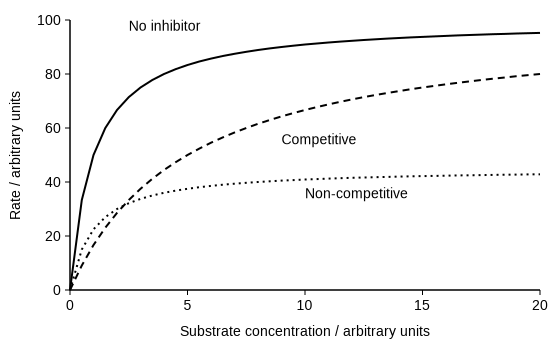
- Substrate concentration: more substrate means more enzyme-substrate complexes, so a faster rate. The curve levels off when all active sites are occupied and enzyme concentration is limiting.
- Enzyme concentration: more enzyme means more active sites and a faster rate, until substrate becomes limiting.
- Temperature: up to the optimum, more kinetic energy means more successful collisions and more complexes. Above it, bonds such as hydrogen bonds break, the tertiary structure changes and the enzyme denatures. The active site is no longer complementary, so fewer complexes form.
- pH: away from the optimum, hydrogen and ionic bonds break, so the tertiary structure of the active site changes. It becomes less complementary to the substrate, or no longer complementary, so fewer complexes form.
- Competitive inhibitor: has a similar shape to the substrate and binds to the active site, so fewer complexes form. A higher inhibitor concentration lowers the rate further. Adding more substrate reduces the effect (see Figure 1).
- Non-competitive inhibitor: binds away from the active site and changes the tertiary structure of the enzyme. The active site is no longer complementary to the substrate, so fewer complexes form. A higher inhibitor concentration affects more enzymes and lowers the rate further. Adding more substrate does not overcome it.
Investigating rate
Required practical 1 investigates how one variable changes the rate. Change only that variable. Keep the others the same: temperature with a water bath, pH with a buffer, and the volumes and concentrations of enzyme and substrate. Run a control with the same substrate and buffer, but with denatured enzyme at the same concentration. Plot the results on a suitable graph, and judge the uncertainty in your measurements. The initial rate is the gradient of a tangent drawn at the start of a product-time curve.
Key terms
- Peptide bond
- the bond formed by condensation between two amino acids
- Primary structure
- the sequence of amino acids in a polypeptide
- Tertiary structure
- the specific folded shape of a polypeptide, held by hydrogen bonds, ionic bonds and disulfide bridges
- Quaternary structure
- more than one polypeptide in a protein
- Activation energy
- the energy a reaction needs to start
- Enzyme-substrate complex
- the enzyme and substrate joined at the active site
- Active site
- the part of an enzyme that binds the substrate
- Complementary
- having shapes that match so that two molecules can bind
- Denature
- change the tertiary structure of a protein so that it no longer works
How this gets examined
- Describe the levels of structure, for five marks: amino acids joined by peptide bonds; by condensation; secondary structure from hydrogen bonding; tertiary structure from interactions between R groups; quaternary structure with more than one polypeptide.
- Explain how an enzyme works: the substrate binds to the active site; the active site changes shape slightly, so that it becomes complementary to the substrate; this lowers the activation energy.
- Explain the effect of a mutation as a chain: a change in DNA base sequence changes the amino acid sequence, so different hydrogen bonds, ionic bonds or disulfide bridges form, and the tertiary structure changes.
- Explain why a hormone binds one receptor: the receptor has a specific tertiary structure, which is complementary to the hormone. Never use enzyme words for a receptor.
- Explain how a competitive inhibitor slows a reaction: it has a similar shape to the substrate, it binds to the active site, and fewer enzyme-substrate complexes form.
- Explain how a non-competitive inhibitor works: it binds away from the active site, the shape of the active site changes, and the substrate can no longer bind.
- Compare the models: in both, the substrate binds to the active site, but only in induced fit does the active site change shape.
- Suggest how to confirm that an inhibitor is competitive: raise the substrate concentration and expect a faster rate.
- Calculate a rate from a graph, using a tangent for a curve. The specification also allows a calculation of pH from hydrogen ion concentration, with the formula given.
Common mistakes
- Calling primary structure "a chain". It is a sequence of amino acids.
- Saying quaternary structure means four polypeptides. It means more than one.
- Putting ionic bonds, disulfide bridges or peptide bonds in secondary structure. Hydrogen bonds hold it.
- Writing "3D" in place of tertiary structure, or shortening "tertiary" to "3°". Write "tertiary structure" in full.
- Saying the substrate, or the whole enzyme, changes shape in induced fit. The active site does.
- Saying a competitive inhibitor has the "same" shape as the substrate. It is similar.
- Leaving out the active site when you describe a non-competitive inhibitor. Say that the active site changes shape.
- Giving active sites to receptors, antibodies or toxins. Only enzymes have them.
- Saying an enzyme is "killed". Enzymes are not alive: they denature.
- Saying higher temperature lowers activation energy. The enzyme lowers it; a higher temperature gives molecules more kinetic energy.
- Heating the biuret test. It works without heat.
Written by Helicate for AQA AS and A-level Biology. Not an official AQA resource. Free for personal study and for use in your own school or college; please don't resell or re-host it.
Spotted something wrong? Report a mistake in these notes.