Stimuli and response revision notes 3.6.1
Organisms survive better when they respond to change. A stimulus is a change that can be detected. A receptor detects it, a coordinator such as the brain links receptor to effector, and an effector, such as a muscle, makes the response. Nervous responses are fast, short-lived and act on a small area. Hormonal responses are slower, last longer and can reach many parts of the body, because hormones travel in the blood.
- Specification 3.6.1
- Level A-level only (not in the AS course)
- Price Free
Practise this section
Test yourself under exam conditions
Plant growth responses
Plants have no nervous system. They respond with specific growth factors that move from growing regions to other tissues. Indoleacetic acid (IAA) is made in the tips of shoots and roots and diffuses to nearby cells.
A tropism is growth in response to a directional stimulus. What IAA does depends on its concentration and on the organ:
- Phototropism in a shoot: IAA moves to the shaded side. Cells there elongate more, so the shoot bends towards light.
- Phototropism in a root: IAA moves to the shaded side and inhibits elongation there, so the root bends away from light.
- Gravitropism in a shoot: IAA moves to the lower side. Cells there elongate more, so the shoot grows upwards.
- Gravitropism in a root: IAA moves to the lower side, but in roots a high concentration inhibits elongation. Cells on the upper side elongate more, so the root grows downwards.
In shoots, a higher concentration of IAA causes more elongation (over the usual range). Root cells are more sensitive, so the same concentration can inhibit their elongation. Where IAA promotes growth, it activates enzymes that make cell walls more plastic (easier to stretch permanently), so cells elongate.
Taxes and kineses
A taxis or a kinesis can keep a mobile organism in a favourable environment. A taxis is a directional movement towards or away from a stimulus. A kinesis is not directional: the organism moves faster, or spends more time moving, in unfavourable conditions, so it is more likely to leave them. In good conditions it slows down and stays.
Required practical 10 uses a choice chamber or maze to find out how an environmental variable affects movement. For example, you could give woodlice a choice of damp or dry air. Keep other conditions the same on both sides. Use a large sample, so that it is representative. Start the animals in the centre, so that there is no bias. Wait before counting, so that they can acclimatise and distribute.
The null hypothesis is that humidity has no effect on how the animals distribute. A chi-squared test compares observed and expected numbers. If chi-squared is above the critical value at P = 0.05, reject the null hypothesis: the probability that the difference is due to chance is less than 0.05.
The simple reflex
A simple reflex uses three neurones. A receptor starts impulses in a sensory neurone, which connects to a relay neurone, which connects to a motor neurone. The motor neurone carries impulses to an effector. Only three neurones are involved and the response is involuntary, so it is fast. A body part can be moved away from harm before much damage is done.
The Pacinian corpuscle
Receptors respond only to specific stimuli. A Pacinian corpuscle responds only to pressure. It has layers called lamellae around the ending of a sensory neurone. This is how it works:
- Pressure deforms the lamellae and the membrane of the neurone.
- Stretch-mediated sodium ion channels open.
- Sodium ions diffuse into the neurone.
- The membrane is depolarised, which produces a generator potential.
Rods and cones
| Rods | Cones | |
|---|---|---|
| Connections | Several rods connect to one neurone | Each cone connects to its own neurone |
| Sensitivity to light | High: spatial summation helps the neurone reach threshold in dim light | Low: no summation between cones |
| Visual acuity | Low: several rods send one set of impulses | High: cones send separate sets of impulses to the brain |
| Colour | One type of pigment, so no colour vision; it responds to low light intensity | Three types, each with a pigment that absorbs a different range of wavelengths; they need a higher light intensity |
Visual acuity means being able to see two close points as separate. The colour you see depends on how strongly each type of cone is stimulated.
How the heartbeat is coordinated
Heart muscle is myogenic: it starts its own contractions. The nervous system only changes the rate.
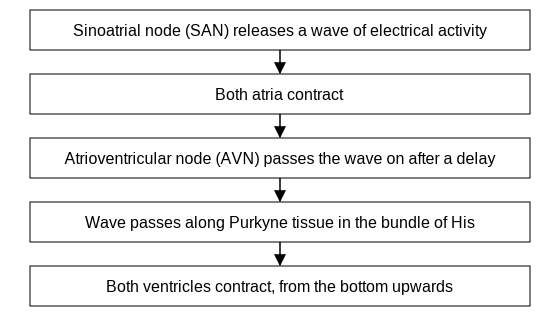
The delay lets the atria empty before the ventricles contract.
Controlling heart rate
Chemoreceptors are in the aorta, the carotid arteries and the medulla. Pressure receptors are in the walls of the aorta and the carotid arteries. When they detect a change, they send more or fewer impulses to the cardiac centre in the medulla of the brain. The autonomic nervous system then carries impulses to the SAN. The effectors are the SAN and heart muscle, which change the heart rate.
| Change | Detected by | Response |
|---|---|---|
| Blood carbon dioxide rises (pH falls) | Chemoreceptors | More impulses along sympathetic neurones to the SAN, so heart rate rises |
| Blood carbon dioxide falls (pH rises) | Chemoreceptors | More impulses along parasympathetic neurones to the SAN, so heart rate falls |
| Blood pressure rises | Pressure receptors | More impulses along parasympathetic neurones to the SAN, so heart rate falls |
| Blood pressure falls | Pressure receptors | More impulses along sympathetic neurones to the SAN, so heart rate rises |
Cardiac output = heart rate × stroke volume (CO = R × V). For example, 70 beats per minute at 80 cm³ a beat gives 5600 cm³ per minute. Rearranged, V = CO ÷ R.
Key terms
- Tropism
- a growth response of a plant to a directional stimulus
- Taxis
- a directional movement of a whole organism in response to a stimulus
- Kinesis
- a non-directional change in movement in response to a stimulus
- Generator potential
- the depolarisation of a receptor's membrane caused by a stimulus
- Visual acuity
- the ability to see two close points as separate
- Myogenic
- able to contract without impulses from the nervous system
How this gets examined
- Explain curved growth: where IAA is made, how it moves, and more elongation of cells on one side.
- Name a behaviour from data and give an advantage that fits the organism, such as being less visible to predators.
- Describe how pressure produces a generator potential: the membrane is deformed; stretch-mediated sodium ion channels open; sodium ions diffuse in; depolarisation follows.
- Explain acuity or sensitivity: connection to neurones, then separate impulses, or summation to reach threshold.
- Explain colour vision from absorption data: each type of cone absorbs a different range of wavelengths, so compare how much each type absorbs.
- Explain how IAA causes elongation: it activates enzymes that increase cell wall plasticity.
- Describe coordination of the heartbeat: the SAN releases a wave of electrical activity; the atria contract; the AVN passes it on after a delay; it travels through Purkyne tissue in the bundle of His; then the ventricles contract. The order matters.
- Explain a change in heart rate: the change, chemoreceptors, impulses to the cardiac centre, the correct autonomic pathway, the SAN.
- Explain how features of a choice chamber method make results valid. Write a null hypothesis that names the variable, justify a chi-squared test, and conclude using the critical value, probability and chance.
Common mistakes
- Writing "messages" or "signals" for impulses.
- Writing "sodium" for sodium ions.
- Saying IAA "accumulates" on the shaded side without saying that it moves there.
- Writing "more growth". Say more elongation of cells.
- Describing phototropism or gravitropism when the set-up has no directional stimulus of that kind.
- Calling a taxis a kinesis or a tropism, or giving the wrong direction.
- Giving "to survive" as the advantage. Name a specific one, such as finding food.
- Writing "red cones". They are red-sensitive, and pigments absorb wavelengths, not colours.
- Leaving out atrial contraction or the delay at the AVN, or confusing the SAN with the AVN.
- Describing the cardiac cycle when asked about coordination. Give the route of the electrical activity.
- Saying chemoreceptors respond only to oxygen. They detect a change in carbon dioxide or pH.
- Saying that chemoreceptors "detect an increase in pH" when carbon dioxide rises. The pH falls.
- Writing "an impulse" when you mean a series of impulses.
- Leaving out the nervous system when explaining a change in heart rate.
Written by Helicate for AQA A-level Biology. Not an official AQA resource. Free for personal study and for use in your own school or college; please don't resell or re-host it.
Spotted something wrong? Report a mistake in these notes.